Cinematic close-up of a stacked stator core finished by Andes Magnetics
Andes Magnetics · High-performance laminated cores

High-performance laminated magnetic cores.

Laser-cut silicon steel and Fe-Co, controlled stack bonding, and magnetic characterization tied to how we actually cut and stack.

  • 0 production-ready laminations
  • 0 process steps to a shipped core
  • 0 positioning tolerance
  • 0 stack factor kfe
01

Design with you

Drawing review, stack-factor check, then steel on the floor.

02

Cut. Stack. Bond cure.

Laser cut, press stack, cure to spec.

03

Measure and ship

Magnetic and mechanical checks, documented results, then ship.

Laser-cut electrical steel lamination blanks
Sheet-metal laminations—the 2D outline your laser program reproduces; kerf and heat-affected zone are what move iron loss if they are left unmanaged.
01

Fiber laser cutting

0.10–0.50 mm electrical steel and Fe-Co strip

Insulated strip in; nitrogen-assisted fiber cut to the 2D blank. Speed matched to gauge, deburr at the cell exit, parameters recorded on the traveller.

Optional sheet witness coupons from the same coil before bonding when the program needs traceable as-cut documentation—scope is agreed in the PO.

Stacked stator core with even teeth and clean lamination edges
Stack height and slot alignment set kfe and the mechanical iron length your field model should use.
02

Stacking & alignment

Controlled stack factor and concentricity

Registered datums, step rotation where it helps thickness spread, calibrated press force so repeat builds hit the same height band.

Target kfe is built in—not a datasheet guess. Coupon stacks under the same compression can back the number on the build documentation.

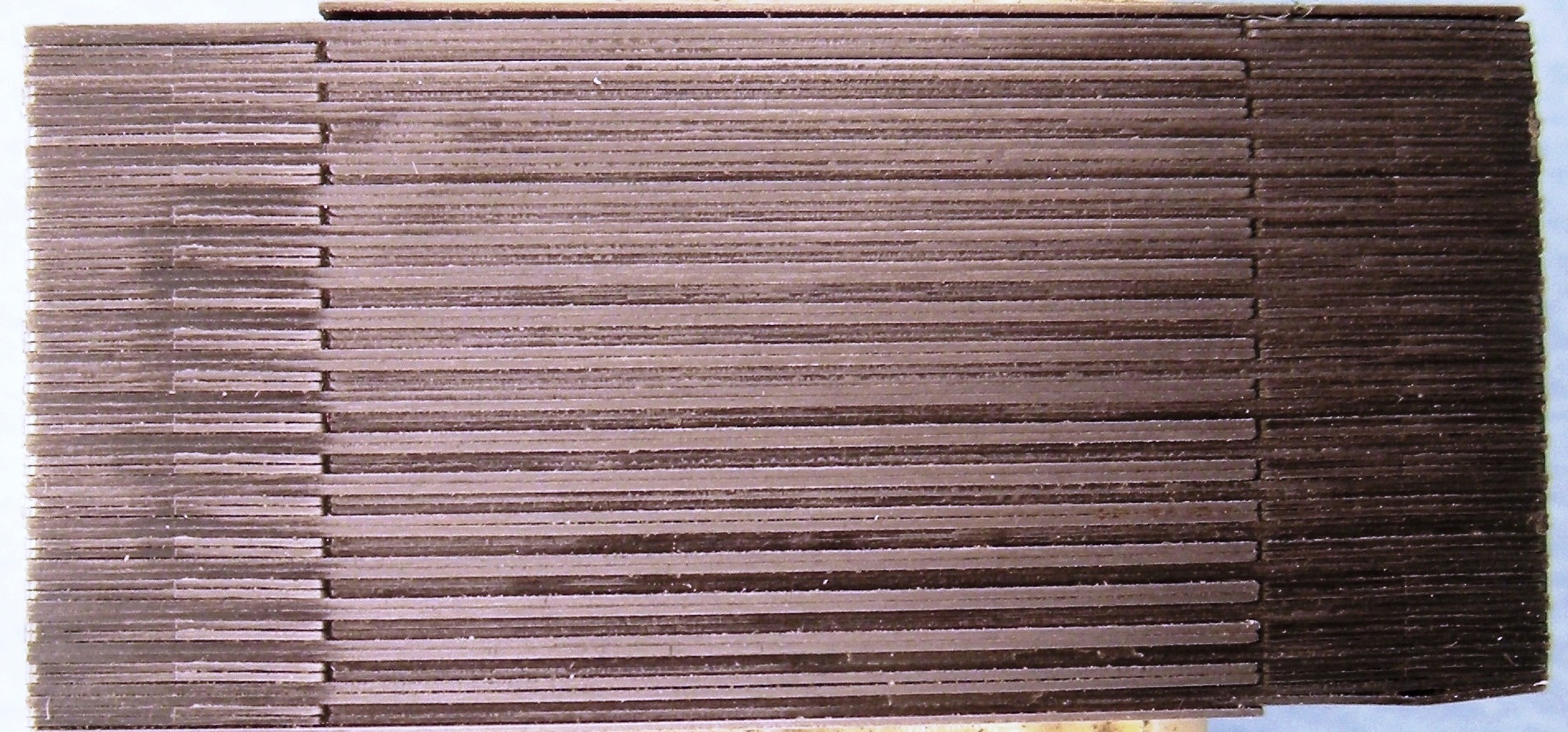
Stacked E-I electrical steel laminations showing separate sheet layers
Interfaces between sheets carry your coating and bond—the geometry that sets inter-sheet insulation and how the stack behaves electrically.
03

Interlaminar bonding

B-stage adhesive, staking, or short OD welds

Rigid assembly without sheet-to-sheet shorts. B-stage epoxy bonding under press, staking where a local short fits the loss budget, OD laser welds only with an eddy penalty called out on the quote.

Traveller lists cure, pressure, and isolation checks on the critical lots.

Controlled-atmosphere furnace for bonding cure under load
Press-in-furnace bonding cure: ramp, plateau, controlled cool with load on so adhesive and stack height stay locked.
04

Bonding cure

Lot cycle under axial pressure

Grade-dependent plateaus (180 / 200 / 220 °C class). Heavy stacks ramp slower so the centre is not undercured while the shell overheats.

Logs + peel on a witness coupon end up on the paperwork. Hiperco lots follow the dry-N2 / high-Tg path the bond Tg demands.

Stack bonding cycle

Bonding cure profile

Setpoint vs. time

Dashed lines: critical alloy temperatures.

Full cycle: --
Core-level verification

Magnetic & stack tests on laminated cores

We ship cores, not raw sheet. Iron loss and flux density are quoted and measured on the assembled stack (or an agreed excitation fixture) over the AC range your design needs.

Core AC loss & flux density

Anchored on your geometry
  • What you get. Specific / total core loss vs frequency at agreed Bpeak (or Bpk map vs excitation), plus no-load current / flux check where the part allows winding access.
  • Sample. Finished bonded core (or pilot stack with the same OD/ID, sheet count, bond, and OD/ID welds). Protocol scales with slot openings and stack voltage limits.
  • Range. 3 Hz – 4 kHz AC (point grid agreed per program); Bpeak set by you within grade saturation and lamination factor.
  • Out. Pfe tables or curves at your (B, f), comparison against datasheet + allowance for teeth/edges, short written route so procurement can audit what was excited.
Precision balance for stack factor measurement
Mass + compressed height → real kfe on the core you ship, not a catalogue guess.

Stack factor kfe

IEC 60404-13
  • Measures. Iron fill vs compressed height on your bonded core—the factor that scales effective magnetic length in FEA.
  • Chain. Balance mass, compressed height at set pressure, lamination area from CMM, literature density.
  • Band. ~0.90–0.98 by grade and bond; ±0.005 repeatability class.
  • Out. kfe, height map, leff for your stack.

Burr & cut edge

Aligned with ISO 9013
  • Measures. Edge quality on laser teeth and slots that become your air-gap and interface surfaces after stack—linked to kfe and coating pull-through.
  • Method. Confocal trace on production-representative teeth; cross-section if recast or micro-crack is in question.
  • Typical. <8 µm burr on 0.35 mm Si-Fe; 15 µm hard cap unless agreed.
  • Out. Profile + micrograph + explicit pass/fail vs stack-factor risk.
Stacked ring laminations for DC B-H testing
Ring stacks give a closed DC path when you need µ(H) and Hc—often cut on the same program as production annular cores.

DC B-H on ring stacks

IEC 60404-4
  • Measures. B(H), µi, µmax, Hc, Br for designs sized on static permeability—not a substitute for AC core loss at PWM frequency.
  • Sample. Wound or stacked rings, typical OD 60–100 mm; geometry can follow your OD/ID/height class.
  • Method. Bipolar ramp, fluxmeter, demag before each trace.
  • Out. Tables, loops, µr(H), file-friendly geometry for reuse in your model deck.

Also available. Rotational loss fixtures, specialist permeameters, coating-specific work—we run in-house or coordinate. Ask for a core-level test plan.

Sales engineering

Instant Quote

Four steps, live USD estimate.

DXF geometry

Lamination outline

Drop your DXF or click to browse

Closed outline only.

Material & stack

From our grade list

Process

Bond cure system

Quantity & testing

Lot add-ons

Tests & documentation

Talk to us

Contact

Send request to Andes Magnetics

Only the greeting below appears as email body lines. Quote details appear as labelled fields plus the DXF attachment. Sends to info@andesmagnetics.com.

Request summary (also sent as form fields)
DXF geometry

Short greeting plus any extra comments; specs are listed above.